
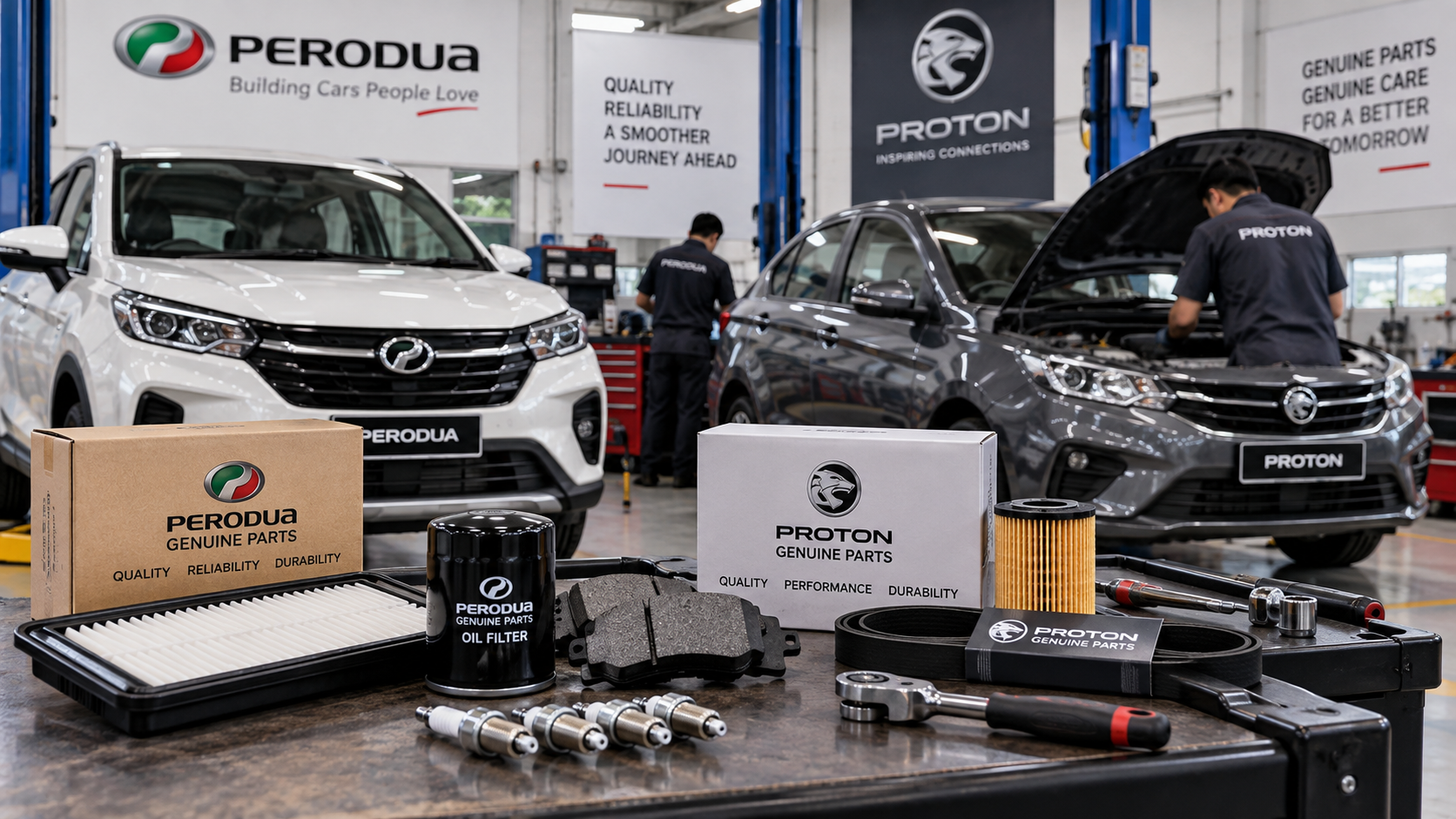
If you own a Perodua or Proton in Sri Lanka, keeping it running well isn’t only about changing the engine oil on time. The quality and specification of the parts fitted to the car matter too.
These cars were engineered around particular components, tolerances and service specifications. Using the correct parts helps preserve the way the vehicle was designed to perform — from everyday fuel efficiency and smoothness to braking, cooling and long-term reliability.
That doesn’t mean every aftermarket part is bad. There are excellent aftermarket manufacturers. The challenge is knowing exactly what you’re buying, whether it meets the required specification, and whether the part is actually genuine.
Why genuine parts can make a difference
Perodua says its Genuine Parts are specifically designed and manufactured according to Perodua standards for optimum performance and durability. Proton likewise recommends approved parts to keep its vehicles operating at their intended level.
For an owner, the important word here is specification.
A replacement component may physically fit your car but still differ in its materials, tolerances, filtration performance, friction characteristics or durability.
That difference might not be obvious when the part is first installed. It can become noticeable thousands of kilometres later.
Pay particular attention to important service parts
You don’t necessarily need to obsess over every clip or piece of trim. Focus first on components that directly affect the car’s mechanical operation, safety or service life.
Filters
Engine oil and air filters look simple, but their specifications matter.
An oil filter must provide the required filtration while maintaining appropriate oil flow. An engine air filter needs to protect the engine without unnecessarily restricting airflow.
For routine maintenance, using a genuine or correctly specified high-quality filter removes much of the guesswork.
Brake components
Brake pads are one area where choosing solely by price can be a false economy.
Different pad compounds can change braking feel, noise, dust levels and how they interact with the brake discs. An unsuitable pad may technically fit while producing an experience quite different from the original setup.
For a normal road-going Perodua or Proton, genuine brake components provide a predictable reference point for the braking characteristics intended for the vehicle.
Spark plugs
The correct plug specification is more important than simply buying a well-known brand.
Heat range, dimensions, electrode design and gap need to match the engine. When replacing plugs, check the exact specification for your model and engine rather than buying based only on the vehicle name.
Belts, seals and engine components
Small differences in dimensions or materials become increasingly important with components expected to operate continuously under heat, pressure and movement.
Timing-related components, seals, hoses, engine mountings and transmission-related parts are areas where buying the correct part is particularly worthwhile.
Fluids matter too
Parts aren’t the whole story.
Engine oil, automatic transmission fluid, CVT fluid, coolant, brake fluid and differential oil should meet the specification required for the particular vehicle.
Don’t assume that a fluid is suitable simply because the bottle says it works with many Asian vehicles.
Check the owner’s manual or manufacturer specification first.
Genuine doesn’t mean you should ignore the part number
One of the easiest mistakes when sourcing parts internationally is ordering for the model name alone.
A Perodua Myvi, for example, has existed across multiple generations, engines and specifications. Proton models can similarly have important differences between generations and variants.
When sourcing a component, provide as much information as possible:
- Vehicle model
- Model year
- Engine size
- Variant
- VIN/chassis number where appropriate
- Existing part number
- Clear photograph of the old component
For some parts, the VIN or chassis information is the safest way to confirm compatibility.
Be careful with unusually cheap “genuine” parts
A genuine-looking box doesn’t automatically mean the component inside is genuine.
Counterfeit automotive parts exist, and packaging can be copied. Perodua itself has previously warned customers about imitation products and encouraged owners to obtain genuine products through authorised channels.
Be cautious when a supposedly original component is dramatically cheaper than the normal market price.
Check the seller, packaging, labels, part numbers and source. For critical components, traceable sourcing is worth paying for.
What about good aftermarket brands?
There is an important distinction between aftermarket and counterfeit.
A reputable aftermarket manufacturer openly sells a component under its own brand. A counterfeit product attempts to pass itself off as something it isn’t.
Quality aftermarket components can be perfectly reasonable, particularly for older vehicles or when the original manufacturer no longer offers a practical option.
The key is knowing the manufacturer, specification and application.
For owners who don’t want to research all of those variables, genuine parts provide a simpler benchmark: a component intended for that vehicle.
Perodua also offers ProGanti, its own more affordable range of approved service parts for Perodua vehicles, which demonstrates that the choice isn’t always simply “original or cheap imitation.”
Maintaining a Malaysian car in Sri Lanka
This is where things become particularly relevant for Sri Lankan Perodua and Proton owners.
Some Malaysian-market parts may not be readily available locally. A workshop might therefore suggest the closest available substitute.
Sometimes that solution is perfectly suitable. Other times, sourcing the correct Malaysian part may be worth the extra effort — especially for components where compatibility, reliability or driving characteristics matter.
If you’re unsure, compare the exact part number and specification before deciding.
The objective isn’t to put a Malaysian-branded box into every corner of the car. It’s to keep the vehicle as close as reasonably possible to the mechanical specification it was designed around.
A practical checklist before buying parts
Before ordering a replacement part for your Perodua or Proton:
- Confirm the exact model, year and variant.
- Check the engine or transmission type where relevant.
- Find the original part number if possible.
- Use VIN/chassis information for compatibility-sensitive components.
- Compare the specification, not just the appearance.
- Be suspicious of unusually cheap “genuine” parts.
- Use trusted or traceable suppliers.
- Prioritise correct-spec components for brakes, engine, transmission and cooling systems.
- Use fluids that meet the manufacturer’s required specification.
- Keep invoices and records of the parts fitted to your vehicle.
Need a Perodua or Proton part from Malaysia?
Finding the correct Malaysian-market part from Sri Lanka isn’t always straightforward.
If you have a part number, product link, photograph or simply details of what you need, send them to MY2LK. We can check sourcing options in Malaysia and help you identify a suitable option before you order.